Interpretability · Interim results
Can a frontier model read a small model's weights? Interim results from a controlled experiment
I gave Claude Opus 5.5 nothing but the raw weight values of a small language model. With no code and no way to run the model, it wrote out every number to change by hand, and took a task from 0% to 77.5%. The harder question is whether it was actually reading the numbers, or just familiar with the task.
TL;DR
- With the output layer frozen, Opus edited the model by hand from the raw weights alone. Across 5 independent trials, task accuracy went from 0% to 77.5% on average. Without the weight values, all 3 trials stayed at 0%.
- The edit touched only 8 rows of the input embedding
embed_in(0.0073% of all parameters). When embeddings were off-limits, it turned 8 neurons in the layer-0 MLP into a lookup table instead, reaching 87.5%. - Decoy test: when the “target row” we showed it was secretly swapped for another word's row, the edited model produced the decoy word (79%) and never the real target (0%).
- What it produced is not a gradient. The edit is nearly orthogonal to the true gradient; it is a one-shot, closed-form step along a path Opus derived itself.
The question
Whether one model can understand another model's weights comes up often, but it is hard to test. Even if a large model manages to fix a small one, it might just know the task, might have seen this public model's weights during training, or might have found a general trick that does not depend on the specific values at all. This experiment rules those explanations out one by one, in a setting small and controlled enough to check every number.
Setup
- Small model: EleutherAI/pythia-14m: d_model 128, 6 layers, separate input and output embeddings.
- Task: 8 random pairs of unrelated English words (for example
stage→system). Whenever the last token is IN_i, the model's next-token prediction should be OUT_i. The original model scores 0%. - Subject: Claude Opus 5.5 with no tools, no code execution, no access to the model and no feedback, and only one attempt. It first chose which weights to read (up to 30,000 numbers). Then, in a fresh session, it wrote out every value to be written into the model explicitly.
- Removing familiarity: Opus was never told the model's name, token strings or token ids, only labels such as IN_i and OUT_i. In addition, every trial applied a secret permutation to the 128 residual-stream dimensions and to the 512 MLP neurons in each layer. The model computes exactly the same function, but every number moves to a new position, so memorised Pythia weights are of no use.
- Controls: no weight values; the same edit applied in the wrong coordinate system; random directions with the same positions and norms; and a decoy test that swaps numbers Opus sees.
Results
| Condition | Trials | Accuracy |
|---|---|---|
| Original model | — | 0% |
| With weights (output layer frozen) | 5 | 77.5% (31/40 pairs) |
| Without weights | 3 | 0% (0/24) |
| Same edit in the wrong coordinates / random direction | 260 evaluations | all 0 |
| Decoy test, scored against the real target | 3 | 0% (0/24) |
| Decoy test, scored against the decoy word | 3 | 79% (19/24) |
| Transformer layers only | 2 | 87.5% (14/16); without weights 0/16 |
Accuracy is counted per pair. A pair counts as correct only if it is predicted correctly in all 64 held-out contexts; in practice every pair was either fully right or fully wrong. With vs without weights: Fisher's exact test p = 1.6×10⁻¹⁰.
What it changed, and how
Before reading any weights, the 5 independent Opus instances each arrived at the same plan. The model has no positional embedding, and every read of the residual stream goes through a LayerNorm, which ignores vector length. So if embed_in[IN_i] is replaced by a vector with a norm in the thousands, pointing along OUT_i's readout direction in the frozen output layer (ln_final.weight ⊙ unembed[OUT_i]), it drowns out everything the later layers add. The exact direction can only come from reading the weights.
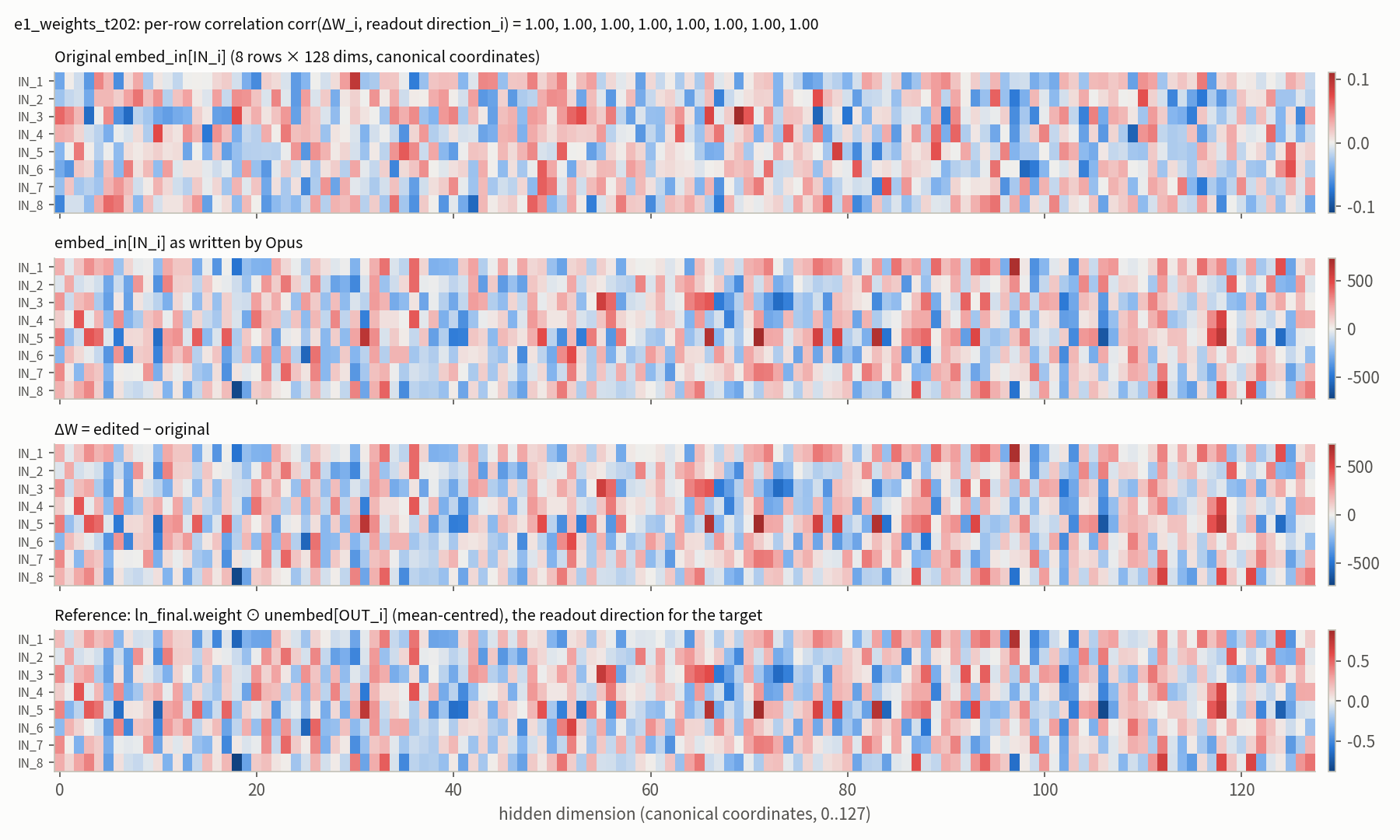
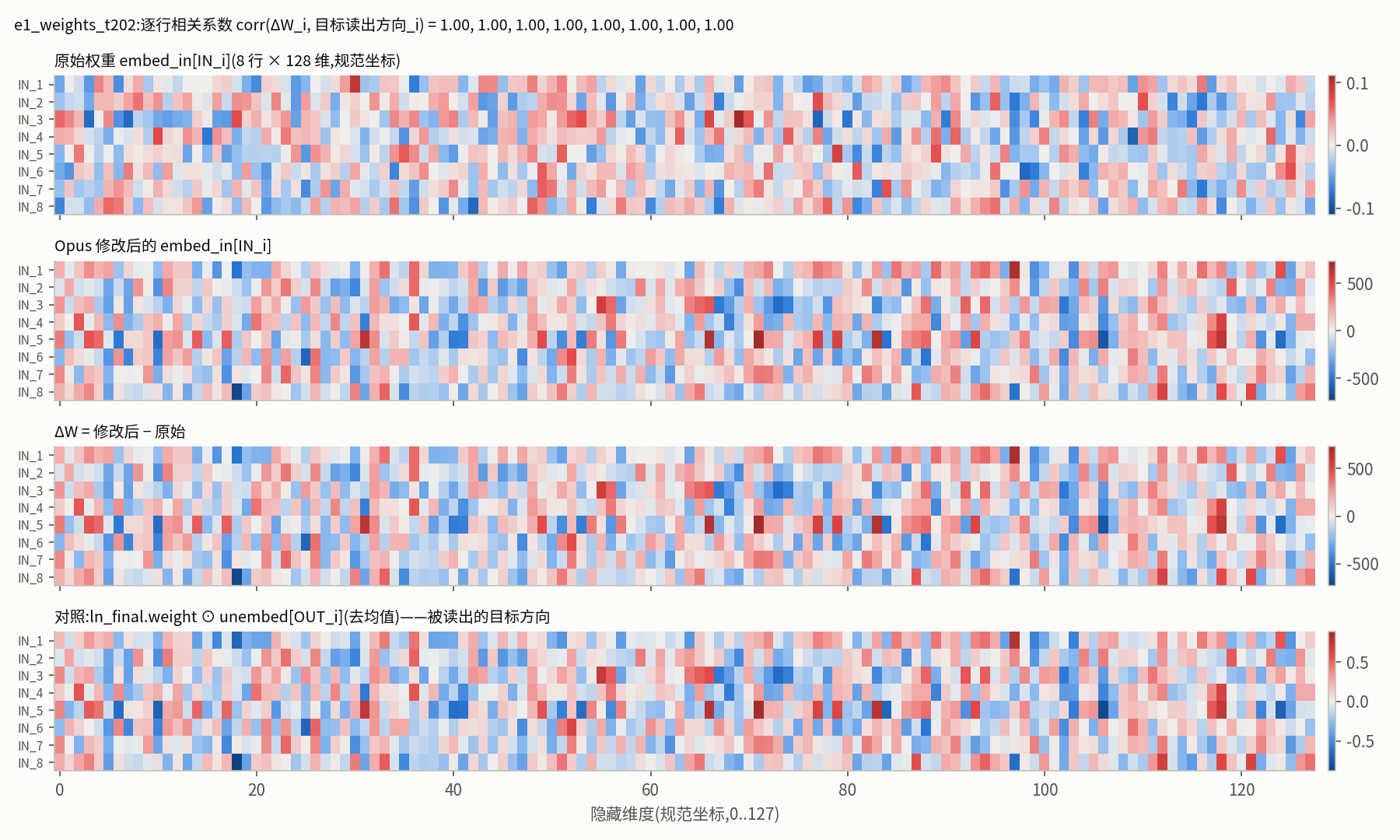
embed_in in task202. From top to bottom: original values, the values Opus wrote, the change, and the readout direction the change should align with. Rows 3 and 4 match pixel for pixel, with a per-row correlation of 1.00.
Opus computed these values by hand while reasoning. For example, dimension 0 of IN_1 was 0.02689 originally; Opus wrote 241.5, and computing its own stated formula exactly gives 241.51. Of the 1,024 values it calculated in this trial, none was off by more than 1%.
When embeddings were off-limits, it used the layer-0 MLP instead. It picked the 8 least active neurons, set their input weights so that each fires only on its IN_i, and set their output columns to write the OUT_i direction, in effect installing an 8-row lookup table by hand. For comparison, full-parameter fine-tuning changes all 76 tensors.
How we know it was reading the numbers
- Decoy test: same task, same secret coordinates, same stage-1 plan. The only difference was that the “OUT_i row” we showed it actually belonged to another word. After the edit, the model produced the real target 0% of the time and the swapped-in word 79% of the time.
- Wrong coordinates break it: the identical edit, applied to the same model in a different but functionally equivalent coordinate system, scores 0.
- The same dimension, found five times:
ln_final.weightin the real model has one unusually small dimension (dimension 96). The 5 instances, each in its own secret coordinates, called it dimension 79, 55, 88, 78 and 88. All five map back to dimension 96. - Without the numbers, it says it cannot be done: all 3 instances in the no-weights group argued that which token OUT_i is lives only in the frozen rows they cannot see, so the task is impossible, and they submitted deliberately harmless edits. One of them described what it would do if it could see the numbers, which is exactly what the with-weights group did.
A surprise: with the output layer editable, 100% without reading anything
The first version allowed edits to any parameter. In that setting, Opus without the weights scored 100% twice. It wrote a set of orthogonal codewords of its own design into the input side and the same codewords into the output side. Since it wrote both ends, it never needed the existing values. In other words, fixing the task does not by itself prove the model read the weights. The main experiment therefore freezes the output layer, so that which token OUT_i is exists only in those frozen numbers.
Is this “providing a gradient”?
No. The edit is nearly orthogonal to the network's true local gradient: cosine −0.01 to 0.08, within random noise. It does align with the analytic gradient of the skip path from the embedding straight to the output layer, with a mean cosine of 0.64. Opus did not backpropagate through six layers in its head. It understood the computation, solved one key path in closed form, and filled in the numbers it had read. The result is a large non-local jump: moving just 5% of the way along the edit drops the task loss from about 11 to 0.2–2.8.
Limitations and what to test next
- The model is tiny (14M), there is a single task type, and each condition has only 2–5 trials.
- This task lets Opus bypass what the small model has learned and simply hijack the residual stream. It shows that Opus can locate, read and correctly use the relevant numbers. It does not yet test whether Opus can understand functions the model already has.
- Every missed pair lost to an obscure subword token Opus could not see: it read only 48 of the output matrix's 50,304 rows.
- After the edit, perplexity on unrelated text rose by 1.3%–19%, more than with well-tuned gradient fine-tuning.
The most important next step is a task that requires understanding existing functions. Examples: find a fact the model already stores and rewrite it, or tell from the weights alone what a particular attention head does. After that come larger models, multi-round reading and editing, and comparisons across models and reasoning-effort levels.